

Stepping into the Association of Biomolecular Resource Facilities (ABRF) Annual Meeting for the first time, held amidst the dazzling and somewhat surreal backdrop of Las Vegas, felt like entering a vibrant ecosystem dedicated to the often-unsung heroes of scientific research: core laboratory professionals. We each arrived eager to absorb insights into best practices, innovative technologies, and the ever-developing landscape of core operations, management, oversight, and governance. The meeting didn’t disappoint, offering a rich tapestry of knowledge exchange, networking opportunities, and even a few “only in Vegas” moments.
This report reflects our personal experiences as we navigated our own paths through the meeting, focusing on the sessions we each attended and the interactions we benefited from. ABRF 2025 was a large meeting with nearly 1,000 participants over 4 days (23rd-26th March 2025), featuring parallel sessions that catered to a diverse audience, ranging from dedicated technical professionals to senior leadership. The conference sessions were complemented by a large exhibition hall packed with our industry partners, manufacturers, and suppliers, providing fantastic opportunities during breaks to learn more about emerging technologies, new instrumentation software solutions, and reagents. Many of the companies took the opportunity for deeper interactions with their customers and attendees through User Group Meetings and Technology Showcase events.
There were several poignant tributes to Spencer Shorte, who sadly passed earlier this year. Spencer thrived on meetings like ABRF and the similar Europe-based Core Technologies for the Life Sciences (CTLS; https://ctls-org.eu/), which he co-founded. He was a pillar of the community that such meetings bring together, generously offering his wealth of experience, deep insights, and enthusiasm to everyone who had the pleasure of talking to him, working with him, or knowing him. Spencer is profoundly missed by many in the ABRF community.
The meeting kicked off with palpable energy at the Opening Keynote by Elisabeth Hausrath (University of Nevada, Las Vegas), who wowed the audience with a journey to Mars, covering the history and ongoing development of rovers that have landed on the surface, jammed full of analytical equipment – multiple core facilities on wheels. Elisabeth showed that many of the rovers have outlived their designed useful life expectancy, opening up new opportunities in Mars exploration and our understanding of the Red Planet. The more recent rovers have collected samples ready for retrieval and return to Earth by future missions. After the keynote talk we learned of commendable work to deepen links and collaboration between ABRF and key overseas organizations such as CTLS (presented by Joe Dragavon (University of Colorado Boulder) and Josh Rappoport (Boston College)) and the Canadian Network of Scientific Platforms (CNSP; https://cnsp-rcps.ca/ presented by Brooke Ring (Queens University)), before the opening reception got underway in the exhibition hall (Figure 1)

An early highlight was the Stratocore (https://www.stratocore.com/) PPMS User Group Meeting. It was of great value to see how the implementations by institutions such as The Salk Institute (Alex Noble), UCLA Broad Stem Cell Research Centre (Maria Dominguez), The University of Louisville (Jennifer Van Duine), and The Rockefeller University (Sonia de Beaufort) are leveraging PPMS modules to streamline workflows, reduce administrative burden, and accurately track equipment utilization. The presentations and lively discussions spanned from the practicalities of stock management to ambitious whole-organization integration with enterprise resource planning (ERP) systems. The session concluded with a sneak peek at upcoming updates that will benefit users, facility managers, and administrators in the future.
A fantastic session tackled the ever-pertinent question of core facility organization, institutional structures, and support models: the intriguing "Centralization Question." Isabelle Girard (University of California, Davis) thoughtfully presented a framework including a spectrum of models from Distributed through Federated to Centralized models. The very definition of what constitutes a “core” and what falls outside that umbrella is a key step for any organization. Together with Joe Dragavon (University of Colorado, Boulder), Isabelle presented the outcomes of a survey on how shared research resources are organized across dozens of US institutions, highlighting the disparate structures and the challenges of concluding. What struck us most was the resounding message that there’s no standardized one-size-fits-all solution; context truly is king, and different perspectives can and do exist, even from people within the same organization. The critical importance of community building as a key benefit of shared resource facilities and their expert staff resonated strongly throughout this session and many others.
Community building continued to be a central focus during the session on “The Currency of Cores – Reporting the Performance of Shared Resources.” Here, the panel highlighted the unique difficulties arising from shared resource cores being utilized by many different research departments, but often reporting to none directly, thereby needing to demonstrate their value to varied stakeholders and administrators who may be separated from the research workflow. Cores are generally adept at enumerating their user base and instrument usage, but less so at showcasing broader metrics in support of the University’s strategic goals. Chris Middleton (Georgia Cancer Centre, Augusta University) emphasized his use of the Balanced Scorecard methodology, initially developed by Kaplan and Norton, to structure his communications with staff and stakeholders, ensuring that operations and reporting metrics align with the department’s overarching vision. Jenny Schafer (Vanderbilt University) discussed her own attempts to inventory the number of published papers that had utilized her core laboratory, with or without reference, and the digital and organizational tools to help quantify this valuable, but difficult to track, metric. Jenny proposed the "Spotify Wrapped "approach to highlighting Core’s annual achievements as an eye-catching, easily digestible showcase. Scott Olsen and Aaron Pitre (St. Jude) expanded on these ideas, emphasizing the need for internal tracking and auditing to generate these statistics. The discussion also touched on the strategic importance of involving core faculty in hiring processes.
The featured speaker on Monday afternoon, the winner of the ABRF Award, recognizing Outstanding Contributions to Biomolecular Technologies, was David Deamer (University of California, Santa Cruz). David brought us away from the laboratory and immersed us in a discussion of Earth’s extreme environments and the possibilities of life emerging from them. Between slides showing him pulling proteins out of volcanoes and acid lakes, he also outlined the development of his nanopore sequencing method and the impressive Oxford Nanopore (https://nanoporetech.com/platform/technology) products that utilize this technology.
For those of us (all of us?) deeply invested in the quality and reliability of the science emanating from our institutions, the session entitled "Rigor, Reproducibility & Transparency Practices for Shared Resources" was a must. After a number of sessions focused on the administrative aspects of core management, it was refreshing to return to the foundations of good science with a topic closely linked to the work of ABRF’s CCoRe committee (https://abrf.org/who-we-are/board-committees/core-rigor-and-reproducibility-ccorre/). The discussion included a staggering number of obstacles that can prevent reproducibility in core work, including the quality of antibodies and other reagents, incomplete notes in preparation and acquisition, a lack of standardized templates for minimum reporting requirements, and quality control checks. The list goes on. The talk included an example of how many drug trials show extreme promise in animal studies but then fail to demonstrate effectiveness in human trials; this is often due to researchers in animal studies failing to “blind” their samples. The panel shared their digital resources for addressing some issues. For example, Michelle Itano (University of North Carolina at Chapel Hill) presented MicCheck_v2, a tool to help ensure the accurate reporting of microscopy metadata. The attendees left with heightened awareness that the experimental rigor of our laboratories and that of the users of our cores can constantly be improved.
Tuesday morning began with a much-anticipated discussion session titled The Core Value Proposition. Subtitled “Articulating the Value and Impact of Cores in a Rapidly Evolving Funding Landscape,” this was the primary session concerning the Trump administration’s impact on funding scientific research in universities. Relevant to all in ABRF, attendees descended on the Silver Room en masse to share their challenges and the various ways the community could adapt to the landscape. The event was so popular that it filled to capacity ahead of its 9:00 a.m. start, and late arrivals were turned away. A second session on the subject provided another opportunity to discuss the topics and exchange strategies, primarily focusing on increasing relationships with corporate sponsors, private businesses, philanthropic donations, and other sources of capital. These were unsurprisingly more somber sessions than most. Still, the atmosphere only reinforced the importance of not only our individual occupations but also the ABRF organization, annual meeting, and conferences in general.
The provocatively titled session, “War for Core Talent II: Exploring Optimal Models of Leadership,” offered universally applicable insights. Sheenah Mische (NYU Langone) and Sherry Thornton (Cincinnati Children’s) highlighted the value of mentorship and 360 feedback exercises, clear career pathways, transparent financial practices for directors, and well-defined roles and responsibilities, whilst Stephanie Petrie (Oregon Health & Science University) emphasized the importance of providing and fostering opportunities for professional development. Andy Chitty (Oregon Health & Science University) introduced his application of concise, one-page impact reports, which quantify contributions to grants, papers, users, and thesis outcomes, providing a tangible tool for demonstrating the value of core staff.
The session on “Tracking, Testing, and Data Management in Flow Cytometry Cores,” moderated by Rachael Sheridan (Van Andel Institute) and Steven Polter (University of Rochester), was a roundtable discussion where attendees shared their own cores’ strategies for project tracking, proficiency testing, and data management. This provided a rare opportunity to learn the particular workflows of colleagues in the field and to share best practices from facilities with different staff, user bases, and resources. We were then well-prepared for the later session, “Research Data Management Strategies for Cores,” which dove deeper into this increasingly hot topic. In addition to the fundamental issues of storage and access, this session explored quality control of data management, reporting standards, strategies for long-term archiving, and the challenges of relying on third-party solutions. One problem frequently encountered is the issue of staff turnover, which can inadvertently lead to data loss or institutional knowledge management. Unfortunately, organizational systems are often established by an individual and not passed on to their successor when that individual leaves.
The final day’s session, “Shared Research Resources and Central Research Administration: Working Together to Advance Research,” served as an excellent complement to Monday’s Centralization session. While the Centralization session focused on the structure of core administrations, the Working Together session instead concentrates on how exactly cores and administrations can communicate with each other to improve their cooperation and efficiency. Lack of communication between core managers and their administrative offices can otherwise create difficulties with compliance, delays in funding, and strained working relationships between departments.
The flow cytometry specialists were attracted to the cleverly titled “What a Cluster: Identifying and Solving Common Pitfalls in Flow Cytometry Data Analysis.” Part lecture and part riddle-mystery, the panel presented t-SNE plots and other analyses that included some classic mistakes in preparation or acquisition. It challenged the attendees to recognize the errors that
had been made. This session served as an excellent reminder that users do not possess the same level of expertise as core staff. That obvious mistakes in acquisition are much harder to detect in analysis after acquisition is complete. Proper training and quality control protocols were emphasized in many sessions throughout the conference, and this session served as an excellent demonstration of why these practices are crucial to users and their experimental data.
Meanwhile, at the session entitled “Building & Benefitting from User Satisfaction Surveys,” Jeff Weiss (Northwestern University - The Feinberg School of Medicine) provided a deep dive into how this is conducted at Northwestern University. His meticulous approach to designing surveys, maximizing response rates, generating insightful reports (including the fine art of well-prepared Excel templates), and strategically linking survey feedback to funding requests was awe-inspiring and offered a clear roadmap for improving user engagement and identifying areas for growth. The idea of utilizing longitudinal tracking and core-to-core comparisons to pinpoint areas for improvement and resource allocation was particularly compelling, and we plan to apply it in our own departments.
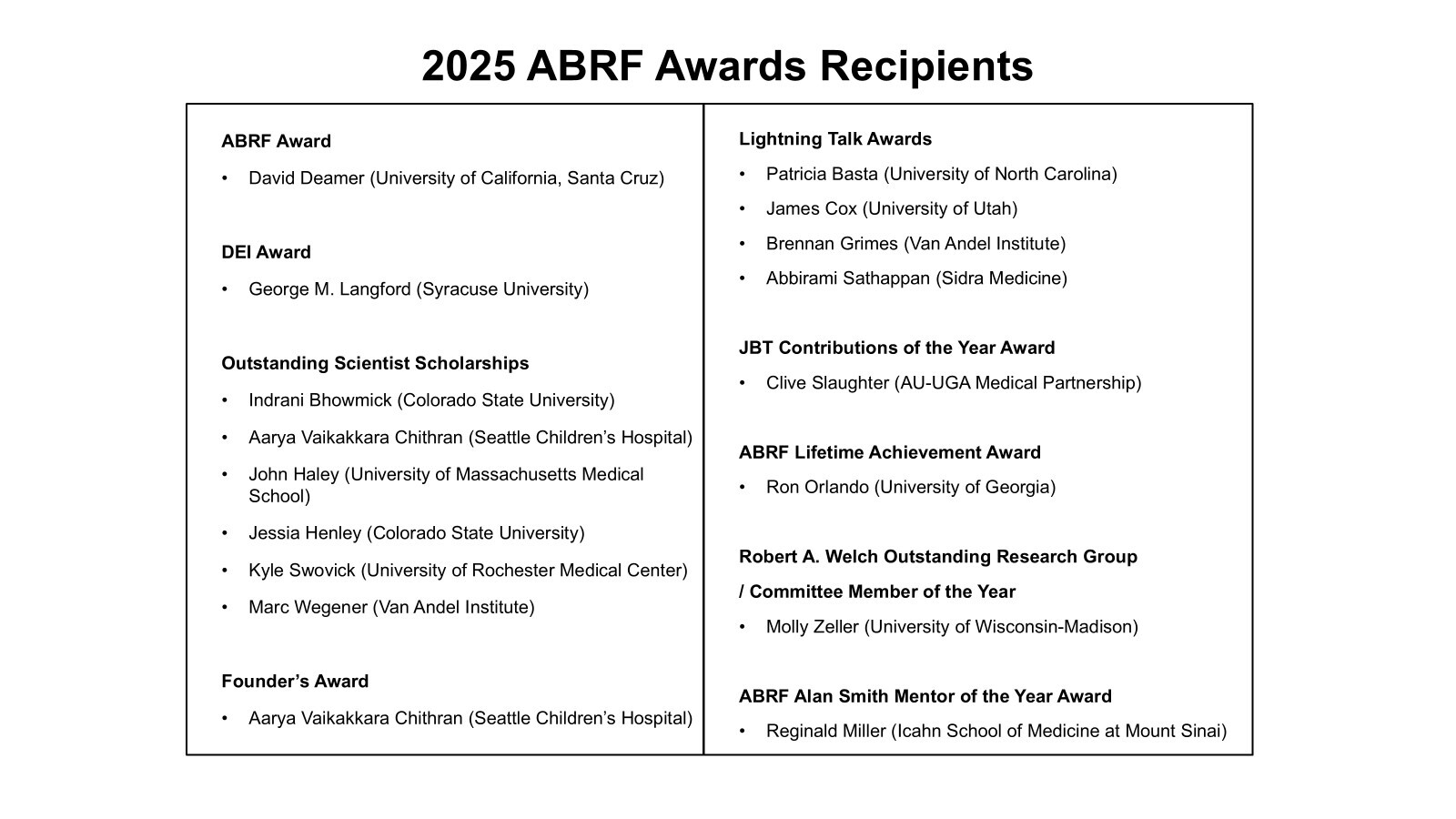
The closing keynote by Anthony Barnhart (Carthage College), "Magic in the Lab: Psychological Insights from Magicians," was a gratifying and intriguing conclusion to the plenary sessions. Beginning with explanations of misdirection, coupled with well-performed rope tricks, Anthony proceeded to move from a discussion of magic in general to his particular field of research: using eye-tracking during misdirection tricks to study perception and attention. Both fascinating and at times hilarious, this thematic close to the academic talks provided an infusion of energy to the crowd ahead of the members’ meeting at which the 2025 ABRF awards were conferred to the deserving awardees (Table 1).
The closing reception at the Paris pool was a fitting end to half a week in Vegas. Arriving from the casino floor, the overwhelming atmosphere of the interior gave way to lovely weather and fantastic conversations with peers, all of whom were equally pleased to have finished their presentations. Drinking wine beneath the faux Eiffel Tower, one could almost forgive the two lifeguards dutifully preventing anyone from entering the pool…alas, no conference is perfect.
Overall, our first ABRF Annual Meeting was an incredibly informative and valuable experience. The level of engagement, the willingness to share best practices, and the strong sense of community within the core facility world are truly inspiring. We extend our congratulations to the organizing team! The meeting served as a timely reminder of the value of shared research resources in a challenging funding landscape. By gathering together, we were able to reinforce the value of our work both within and beyond our individual institutions. Amidst the, at times, overwhelming atmosphere of Las Vegas, ABRF organized an efficient, educational, and extraordinarily social event that reminded us that the community at large is our most significant shared resource. We left Las Vegas feeling energized, armed with new ideas and connections, and already looking forward to the next meeting.

Background of the authors
Graham D Wright (Director, Research Support Centre, Agency for Science, Technology & Research (A*STAR), Singapore. ORCID: https://orcid.org/0000-0003-2362-1312
Graham was an international attendee of ABRF with a background in microscopy core management and, more recently, progressing to overseeing multiple cores in a central administrative role, leading A*STAR’s Research Support Centre (RSC; https://www.rsc.a-star.edu.sg/). He co-founded the National-level SingaScope [www.SingaScope.sg] project, bringing together a partnership of leading microscopy cores. More recently, he has also established a regional-level collaboration with partners in neighbouring countries, launching Imaging South East Asia (iSEA; [https://www.imagingsea.org/]). Having heard many great things about the ABRF annual meetings from colleagues and friends, Graham was excited to attend his first in-person conference.
Ryan M Wantroba (Flow Core Manager, Columbia University Irving Medical Center, New York, NY, USA)
Ryan was a first-time attendee to the ABRF annual meeting in his second year as a Flow Cytometry Core Manager at Columbia University. He manages the Microbiology & Immunology Shared Resources as well as staffing the Columbia Stem Cell Initiative Flow Cytometry Core under the direction of Michael Kissner.